MARKET PERFORMANCE-As off March 13, 2026
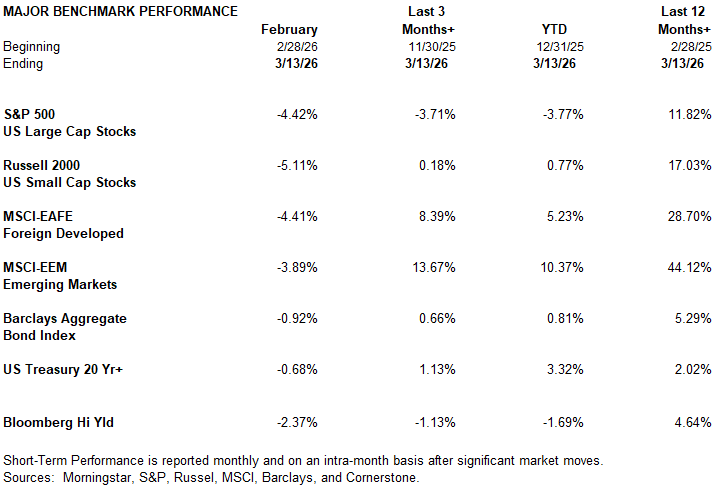
War in Iran: The U.S. and Israeli attack on Iran has eliminated the current Iranian leadership and leaves many questions related to future leadership. Blockage of the Strait of Hormuz would reduce oil supplies and cause upward price pressure. Morgan Stanley has published research going back to the Korean War in 1950 that looks at geopolitical events and market performance. This report shows that over one, six and12 months after the events the S&P 500 has been up on average by 2%, 6% and 8% respectively. There is no assurance that markets will remain calm, but history indicates that these events don’t typically have a large impact on markets. Obviously, there are large concerns related to stability in the region, loss of life, and longer-term prospects for peace.
Tariffs: The Supreme Court ruled against the tariffs that fall under the Emergency Powers Act. These tariffs constitute the largest share of the current tariff structure, but President Trump announced a new 15% global tariff to attempt to maintain the current level of revenue at approximately $260 billion a year. It is difficult to know how this plays out as it introduces another round of uncertainty.
New Fed Chair: President Trump selected Kevin Warsh to be the new Federal Reserve Chair starting in May, replacing Jerome Powell. President Trump wants lower interest rates and Warsh’s preference for low interest rates is partly based on a belief that AI will be a deflationary force. He also believes that lower borrowing costs will help keep prices lower for consumers and small business. The deflation thesis hinges on AI’s making some employees more productive, but it also risks putting others out of work.
Fed Rate Cut Status:
The Federal Reserve held interest rates steady in its January 28th meeting and communicated their “dot plot” consensus for one additional 0.25% cut in 2026. The Federal Reserve had previously reduced the Fed Funds Rate by 0.25% to a range of 3.5-3.75% on December 10. Fed Chair Jerome Powell characterized the cut as risk management based on a softening job market carrying more risk than stubborn inflation. Job data has been softer in recent months as corporations appear to maintain a “No hire, no fire” mode. Core Personal Consumption inflation is expected to end 2025 at 2.9%, 2.4% by year-end 2026, and 2.1% by year-end 2027. US GDP growth is seen at 1.7% for 2025 and 2.3% for 2026.
Federal Reserve Chair Jerome Powell continues to pursue a lower inflation rate without tipping the economy into a “hard landing” recession. Although President Trump considered firing Powell, his current focus is the replacement for Powell whose term ends in May 2026. He continues to pursue a criminal investigation into Fed Governor Lisa Cook. Meanwhile, he is certainly cognizant of adverse market reaction over concerns of Fed independence. Looking back in time, the Fed began lowering rates at the 9/18/2024 Federal Open Markets Committee meeting, and has now lowered the Fed rate by 1.75%. The Fed was originally surprised by the speed that inflation accelerated after the pandemic, but was also initially surprised how quickly inflation fell through 2023. Inflation declined earlier in 2024, but current inflation reduction progress stalled in 2025 and is proving to be more “sticky”. Tariffs appear to have had only a marginal impact on inflation so far, but may prove more problematic in 2026. The policy goal is to normalize short rates at lower levels, but this may take longer than either the Fed or the market wants. The Fed remains committed to pushing inflation down to the 2% target without causing a recession. Although a soft landing has been difficult to achieve in the past, the economy has remained positive. Recent tariff actions have caused renewed fears of either stagflation or a recession.
2025 Performance:
Precious Metals Strength:
Markets were particularly strong in 2025, and were led by many that were laggards in the past. Gold was a major surprise, gaining 64% to $4,324/ounce and silver was up 140%. Gold benefitted from Fed Reserve rate cuts, concerns about burgeoning US debt at $38 trillion, safe-haven buying and even consumer demand for gold at Costco. Foreign central banks also increased gold purchases as they diversified away from a weakened U.S. dollar in what is described as a currency debasement trade. With inflation eroding the purchasing power of fiat currencies, gold regained appeal as a store of value.
Silver gained based on strong fundamentals for solar, AI, wireless networks and continuing EV demand.
Historically, such strong gains in gold have often coincided with weak equity markets—making 2025’s simultaneous strength in both metals and stocks particularly notable.
International Equities Outpace U.S.
Foreign stocks delivered standout performance:
-Developed international stocks (MSCI EAFE): +31.2%
-MSCI Emerging markets: +33.6%
Both benefited from cheaper valuation levels and a weaker U.S. dollar. Emerging markets, in particular, were helped by a catch-up from many years of institutional underweighting. Despite accounting for 51% of global GDP and 85% of the world’s population, emerging markets represented only 24.5% of global market capitalization entering 2025.
Top-performing countries included:
- South Korea: +76%
- South Africa: +64%
U.S. Equities: AI Dominated in 2025 :
U.S. markets continued to be driven by artificial intelligence (and especially semiconductors) with Nvidia up 39% and Micron up an extraordinary 239%. The Nasdaq, with a high weight of AI, gained 20% and the S&P 500 was up 17.9%. Although the “Magnificent 7” has dominated performance in recent years, only two members of the Mag 7—Alphabet and Nvidia—outperformed the S&P 500 in 2025.
The Big Beautiful Bill and Tariff Tantrums:
President Trump’s Big Beautiful Bill is projected to add an additional $3.4 Trillion to the burgeoning U.S. federal debt over the next 10 years according to the Congressional Budget Office. Many economists describe the current fiscal imbalance as unsustainable, and there is increasing dialog about reducing deficits to avoid higher future interest rates. The stated tariff policy goal has been to protect American industries, reshore manufacturing, and serve as a source of government revenue. The tariffs, now subject to Supreme Court review, that were announced by Trump on the April 2nd so-called “Liberation Day” would have raised the average effective U.S. tariff rate from 2.5% in 2024 to around 22.5%, according to the Yale Budget Lab. These tariffs are almost universally described by economists as a tax on consumers. Investors have wrestled with whether Trump’s hardline tariff policies were negotiation tactics designed to ultimately reduce trade barriers or whether they represented an ideological rejection of free trade and globalization. It appears that Trump reacted to the initial sharp downside market volatility and broad-based criticism as he moderated some of the highest tariff levels. At this time, it is difficult to know the outcome of the Supreme Court decision and what other steps Trump might take.
While the magnitude of budget deficits and inflation are difficult to quantify, there is widespread belief that deficits and inflation will rise. These increases will provide a headwind for longer-term stock and bond market performance.
Geopolitical:
President Trump is dealing with the war with Iran and is attempting to negotiate an end to the war in Ukraine. The situation with Israel and Iran in the Middle East has expanded and it is difficult to gauge the longer-term impact. It will take time to determine the transition in Venezuela. At this point, markets are focused on oil prices and weaker economic growth, and it is difficult assess the longer-term impact.
Stocks and Bonds Up in 2024:
Most major stock indexes were positive in 2024 as corporate earnings improved and the economy proved to be resilient. Meanwhile, longer-maturity bonds had the weakest performance in fixed income markets.
Positive Performance in 2023:
Equity markets were volatile but positive in 2023. U.S. large cap, and especially the so-called Magnificent 7, were particularly strong. Fixed income markets were negative earlier in the year, but rebounded strongly based on declining inflation and the prospect of future Fed rate cuts. The government debt default was averted as expected, fears related to a potential banking crisis proved manageable and inflation trended down. Large financial institutions are well capitalized and have reasonable risk control management, but mid-sized banks were more problematic. Silicon Valley Bank realized large losses when they were forced to sell underwater longer-term bond holdings to fund panicked investor withdrawals. Signature Bank troubles related to a concentration of commercial real estate and crypto exposure. Credit Suisse has been a weak performer for years, and was not able to fund investor withdrawals. The Federal Reserve raised interest rates by 0.25% on July 26, to a range of 5.25% to 5.50%, a 22-year high. The Fed remained “data dependent” and is now on track to allow interest rates to move down in 2025.
2022 Performance Was Ugly:
The U.S. stock market and the bond market were both down sharply in 2022, with all major asset categories down on a year-to-date basis. The S&P 500 performance was down -18.1% 2022. The Bloomberg Aggregate Bond Index fell -13.1%, the worst decline ever. A diversified 60/40 equity/bond portfolio fell over -15%, the worst performance since 1937.
Breaking Things:
The Federal Reserve was too slow in recognizing inflation, and had to play catch up by ratcheting up interest rates much more quickly than past cycles. The Fed communicated the need to take strong medicine to avoid a lot more pain later and for much longer. The cost of doing too little on inflation outweighed the cost of doing too much. As a result, interest rates were raised at an unprecedented rapid rate, and there was fear that the Fed would break the economy and cause a “hard landing” recession. So far, the economy has proven to be remarkably resilient while inflation has declined. The current narrative is for a soft landing where inflation subsides without the pain of a deeper recession. Although the fear that the fed would break the economy has not yet materialized, it is difficult to know the longer-term impact from the higher interest rates, and either a recession or 1970s era stagflation is still possible. Regardless, the debate continued regarding whether or not the Fed raised rates too high and maintained these higher rates for too long. So far, inflation has come in above expectations, and the market now sees potential rate cuts later in 2026. Tariffs have the potential to keep inflation above the 2% target rate and thus keeping short-term interest rates somewhat higher.
Inverted Yield Curve:
The bond market was in an inverted yield curve position starting July 2022 as short-term Treasury interest rates moved above the longer-maturity U.S. 10-year Treasury Note interest rate. This inversion of the maturity timeline resulted from the Federal Reserve pushing up short-term interest rates to control inflation while the broader bond market, fearing a recession, pulled down long-term interest rates. (The yield curve typically has an upward slope with lower short-term rates than higher long rates as investors require a higher rate to compensate for the longer maturity commitment and unanticipated inflation.) The inverted yield curve was been inverted for a longer time span than at any other time in history, and an inverted yield curve has preceded the last seven recessions. Nevertheless, the economy has slowed somewhat but there are few clear signs of an imminent recession. Most recently, the yield curve has un-inverted into a more normal structure with short rates lower than longer-maturity rates.
GDP:
The U.S. economy grew by a weaker than expected annualized rate of 0.7% in 2025 Q4, as the government shutdown negatively impacted output. Underlying trends remained positive, however, as consumer spending and business investment remained steady. The Federal Reserve GDP forecast for growth for calendar year 2026 is 2.3%.
Crypto Collapse, Recovery and Drop:
Cryptocurrency is experiencing negative performance so far in 2026 and legislation to clarify industry guidelines is currently stalled. Stable coins represent the most recent dynamic in the crypto universe. These stable coins are typically backed by the U.S. dollar, and consequently are less volatile than bitcoin and other crypto currencies. Stable coins are beneficial for real-time and cross-border transactions. Crypto performance was very strong in 2024 based on expanded availability of “spot” ETFs and on President Trump’s pro-crypto policy statements. Crypto assets remain a speculative investment, and performance has been negative in 2025 and early 2026.
The crypto exchange FTX (previously one of the biggest crypto exchanges in the world) declared bankruptcy in late 2022. After revelations of risky, unethical business practices, there was a surge of customer withdrawals. Meanwhile, FTX had loaned out customer funds and then didn’t have sufficient funds to cover the customer withdrawals. Unfortunately, investors using the FTX exchange are facing a challenging legal battle in getting their crypto deposits back because the bankruptcy process typically treats their deposits as uncollateralized unsecured claims. FTX had been trading far above any fundamental value, so the precipitous decline was no surprise. Sam Bankman-Fried, former FTX CEO, has been convicted of fraud on all charges. Bitcoin, the largest blockchain-based digital asset traded on crypto exchanges, dropped from a then all-time high of $68,991 in late 2021 to under $17,000 after the bankruptcy announcement, but it has since recovered somewhat. Matt Damon, Steph Curry, Gisele Bündchen and others previously pitched cryptocurrency exchanges, and this bankruptcy debacle shows the importance of financial advice from experienced professionals rather than celebrities. It is also ironic that the NBA’s Miami Heat have changed the name of their home arena from the FTX Arena to the Kaseya Center.
The FTX bankruptcy has not posed systemic risk to the traditional financial system, a so-called “Lehman” moment that helped precipitate the 2008 Great Financial Crisis. This experience clearly highlights the value of established exchanges like the New York Stock Exchange and the regulatory infrastructure protecting investors. During 2024 the SEC has approved a number of spot crypto ETFs that make investing much simpler. In 2025 crypto performance was negative despite a more crypto-friendly regulatory environment. So far in 2026, crypto has been volatile with continued negative performance.
Short-Term Positive:
Household debt levels are in good shape. The household debt-service ratio is below 10% of disposable personal income, and well below the average level going back to 1980. Cash as a percentage of total household debt is also well above average historic levels.
U.S. corporate balance sheets are strong with U.S. corporate debt to after-tax profits low compared to historic levels. Interest coverage on debt is at the highest levels since the 1990s.
–Corporate earnings surprised to the upside during 2021 and 2022, but earnings growth was weak at only 0.4% in 2023. FactSet reported that 2024 earnings growth recovered strongly to 9.4% and revenue grew 5.0%. For 2025, FactSet sees earnings growth of 12.3% and revenue growth of 7.0%. For 2026, FactSet sees earnings growth of 14.9% and revenue growth of 7.2%. If inflation does not continue to trend downward, then broad-based consensus earnings growth could be revised downward.
–Geopolitical risks. Although wars are tragic, history shows that the market generally has positive performance a year after hostilities begin. Blockage of the Strait of Hormuz poses the biggest risk to tighten global oil supplies and force oil prices higher.
–Retail sales. Core Retail sales were down -0.2% in January, as consumers adjusted to the impact of tariffs. Retail sales were up3.5% in 2025.
–The One Big Beautiful Bill Act was signed on July 4 2025 and the largest impact was to extend lower individual tax rates that were scheduled to expire December 31, 2025. The debt ceiling was raised by $5 trillion, various tax credits were rescinded, and the overall impact is expected to increase the federal deficit by around $3.8 trillion over the next decade according to the Congressional Budget Office.
Short-Term Negative:
–The US Dollar was strong in 2024 but was down -9.4% in 2025. The strong dollar in 2024 negatively impacted domestic, foreign developed and emerging markets. The stronger dollar hurt domestic companies with significant foreign sales. Moreover, foreign purchases of oil and other imports are typically transacted in US dollars, and this hurts their local economies. As the Fed seeks to normalize interest rates at lower levels, the dollar has weakened, and tariff policies have caused downward pressure on the dollar in 2025 and early 2026.
–The Conference Board’s Leading Economic Indicators index was down -0.2% in January. Although the Leading Economic Indicators have been mostly negative for the last two years the Conference Board sees slow but positive US GDP growth for 2026.
-Recession and Market Performance. The S&P 500 dropped -39% from the January 3 2022 all-time-high to the October 2022 bear market low. Performance rebounded but was still down -18% for 2022. The S&P 500 surged 26.3% in 2023, and gained 25.0% in 2024 and 17.9% in 2025 Markets remain volatile early in 2026 based on fears of a tariff-related global trade war. At this point, a recession does not appear imminent, but the economy is slowing, especially for manufacturing. looking back, there have been 17 bear markets since World War II and the average decline has been -31%. Of the 17 bear markets, 9 were accompanied by a recession, and the average recessionary decline was -36%.
–Consumer inflation has been proving to be sticky in recent months, and the February Core CPI report increased at a 0.2% rate. The February headline Consumer Price Index was up 2.4% over the last twelve months. The February core CPI, net the volatile food and energy sectors, was up 2.5% year-over-year. Although inflation has trended down from levels not seen since the early 1980s, the Federal Reserve policy to raise rates appears to have been successful so far. Although inflation has declined significantly, recent data shows inflation coming down more slowly than the market prefers and tariffs are expected to be an ongoing headwind. As a result, there is no assurance that inflation will quickly move back to the 2% target level.
–The so-called Fed Put gave investors a measure of downside support for the markets over the last decade. (In the options market, a “Put” position increases in value when markets decline and thus provides an upside offset or hedge against market drops.) Although there was no actual market “Put”, the Federal Reserve purchased massive quantities of bonds and kept interest rates abnormally low to support the economy and the markets. Now that the economy is strong and inflation is above the Fed 2% target, the Fed no longer has the latitude to keep interest rates low to support the market. Instead, there is a need to maintain higher interest rates to mitigate against inflation. Although interest rates are moderating from the higher levels in 2023, they remain sufficiently high enough so that consumer and corporate spending growth rates decrease. It remains to be seen, however, if the Fed would stay on the sidelines in a sharp market decline.
–The Federal Reserve’s monetary stimulus kept interest rates low in the past but it had the effect of distorting markets by shifting investors towards risky assets. More recently fiscal stimulus has been at unprecedented levels based on deficit spending during a time of economic growth. Moreover, the economy is slowly adjusting to more normal interest rate levels. Commercial real estate appears to be the most negatively impacted sector.
–Asset price inflation for both stocks and bonds pushed market prices well above average fundamental valuation levels by year-end 2021. Valuation levels moderated in 2022 but are now relatively expensive again based on the strong 2024 and 2025 stock market performance. It will be important for corporate earnings to sustain strong growth throughout 2026.
–Investors took out record volumes of margin debt to finance their stock purchases. Buying stocks on margin is extremely lucrative as long as stocks continue to move up, but a market downdraft causes heavy selling to meet margin calls. Option volumes are also at record high levels according to the Options Clearing Corporation. Purchasing Options in a rising market allows much larger gains than buying stocks, but losses are amplified in a sharp sell-off. Market makers who sell options to investors typically hedge their position by purchasing the underlying stock. When markets decline and option purchases decline, market makers sell their stock holdings. Margin debt and option purchases provide upward momentum, but these trading tactics also cause severe negative volatility.
–Evergrande is a Chinese property developer that defaulted on bond payments in its $300 billion debt holdings in 2021, and filed for bankruptcy in 2023. Evergrande was ordered in 2024 to liquidate, and this had significant negative implications. Country Garden and other Chinese property developers are also experiencing cash flow problems, and the property sector is a clear drag on the Chinese economy. The market fears “contagion” that spreads throughout the Chinese economy and into international markets. China has expanded support for the economy in 2025, but a resumption of stronger longer-term growth looks unlikely.
Longer-Term Fundamentals:
Federal Reserve “Tapering” Increased Interest Rates and Negative Performance:
The Federal Reserve’s belated recognition of inflation risks and its policy shift spooked markets and caused negative returns for most asset classes in 2022. The shift to higher interest rates is described as the end of easy money.
The policy shift was publicized by the Fed on December 15, 2021 with commentary that they are ending their bond purchases and introducing a policy to raise short-term interest rates to combat inflation. The government bond purchases began at the height of the pandemic to help support the economy and markets when businesses were closed and unemployment skyrocketed. The government bond buying helped reduce interest rates. (Interest rates on existing bonds declined because Fed purchases drove up bond prices and correspondingly reduced interest rates.) Starting in March 2022, the Fed pushed up interest rates at the fastest pace in the last 40 years. As of July 2023, the Fed Fund Rate had been pushed up to a range of 5.25% to 5.50%. As inflation moderated, the Fed was able to cut rates by 100 basis points in 2024. Since rate changes impact the economy with a “long and variable lag”, neither the Fed nor anyone else can know exactly how much the economy has been impacted. At this point, the economy has shown remarkable resilience. The Fed is in a wait-and-see mode and continues to be “data dependent,” but is expected to continue to reduce short-term interest rates by 0.25% later in 2026.
U.S. Economic Statistics are solid and inflation concerns are slowly moderating. Economic statistics dropped precipitously due to the government-induced shutdown in early 2020, but then rebounded well above consensus expectations. Most recently, economic reports are showing a softening growth rate.
-Retail sales have been stronger than expected over the last year despite rising food and housing prices. Fiscal stimulus has ended but U.S. households accumulated over $2.5 trillion in excess savings during the pandemic, and this drove strong consumer spending throughout 2023. Real wage gains sustained consumer spending in 2024. Consumer spending has been strong in 2025 but consumer confidence and sentiment indicators show growing concerns.
-Unemployment (at a 50-year low of 3.5% in February 2020) spiked to 14.7% as the pandemic shut down the U.S. economy, but now stands at 4.4% for January 2025. Job creation for January came in at a disappointing-92,000 new jobs.
-Industrial production was up 0.7% in January but faces headwinds from tariffs and supply chain concerns. Industrial production is up 2.3% year over year.
-Housing had been strong due to low mortgage rates, but new construction is currently negatively impacted by relatively high mortgage rates and rising construction costs. These rising costs impact housing affordability, especially at the lower price points for younger families.
-Inflation had been low over the past decade, but ramped up to historically high levels due to COVID-related supply constraints, high fiscal spending and other factors. Higher interest rates have helped push inflation to lower levels. The overall January Core Consumer Price Index came in at a trailing 12-month 2.5%.
-The Eurozone reported 2025 GDP at 1.5% based on a gradual recovery from the Russian invasion of Ukraine and the corresponding energy price hikes. Inflation has now slowed to its lowest level in more than two years. UK GDP is estimated to be up 1.3% for 2025.
-Japan’s gross domestic product is estimated to be up 1.0% in 2025.
-China reported 2025 GDP growth of 5.0%, showing that their economy is surviving the impacts from tariffs. Skepticism remains regarding the actual GDP performance, and it may be somewhat overstated. Chinese economic performance is a major factor for overall global growth.
-US annualized Q4 GDP came in at 0.7% as it was negatively impacted by the government shutdown. Underlying trends appear stable.
Performance: Stocks and bonds were up in 2025. Looking back, U.S. stock indexes moved up to record-high levels based on government stimulus and optimism with COVID-19 vaccine in 2021, but performance in 2022 was negative. Energy, industrials, financials and small cap stocks performed better as the market rotated away from some of the tech darlings. After the huge 2022 sell-off, stocks recovered strongly in 2023 through 2025. Small cap stocks are cheaper and have more earnings upside as the economy recovers from inflation.
Longer maturity bonds underperformed in 2022 as interest rates rose, but are performed better in 2023. While fiscal stimulus was necessary due to COVID restrictions and lockdowns, there is a growing concern related to persistent inflation and to huge government budget deficits. Investors are less willing to accept historically low longer-term government debt, and this is pressuring long-maturity bond prices lower as yields move higher. As a result, 2024 performance showed modest gains for shorter-maturity bonds, but negative performance for longer maturities. High yield bond performance was solid in 2024 based on a surprisingly resilient economy and reduced near-term prospects for a recession. Bond market performance in 2025 was positive, especially for shorter maturities and for investment grade and high-yield corporate credits.
–Climate change constitutes a significant longer-term global challenge. Although governments and corporations are taking steps to mitigate the impact, recent increased energy costs have caused a consumer backlash. It is much easier to talk about reductions far out in the future, than it is to implement current steps to make actual changes.
Market valuations are down but are not cheap. At this point, markets are trading on recession fears and the prospect of weaker corporate earnings growth. Various valuation metrics (like Price/Earnings ratios) are down, but could decline further if earnings growth is negatively impacted by inflation. It is important to remember that valuation doesn’t predict short-term performance, but valuation definitely impacts long-term performance potential. In other words, markets could move up or down on a short-term basis, but the longer-term performance might be a 5% average long-term return/year rather than the historic 10%/year return.
Stimulus packages helped in the short run, but debt keeps growing. Three stimulus bills have been enacted since the beginning of the pandemic in March 2020. These bills are summarized below:
-The $2.2 trillion CARES Act, passed quickly in March 2020, provided $1,200 direct payments and enhanced unemployment benefits.
-The $900 billion Pandemic Relief Bill passed in December 2020. This provided $600 in direct payments to eligible individuals and $300/week in extended unemployment benefits through March 2021.
-The $1.9 trillion American Rescue Plan passed in March 2021. This plan included $1,400 direct payments to most Americans and extended additional unemployment benefits through the summer.
The U.S. federal debt stands at $38 trillion, and is expected to continue to grow for the foreseeable future. Although current interest rates remain low, future inflation could cause rates to rise, and this would cause sharply higher debt service costs. This is clearly a headwind on a longer-term basis.
For more detail see:
Cornerstone maintains significantly more data and graphs than what is presented in this website. Contact Jeff Johnson regarding specific data questions and comments.
Yahoo Finance link is helpful for daily market activity: http://finance.yahoo.com/
 Cornerstone Investments